


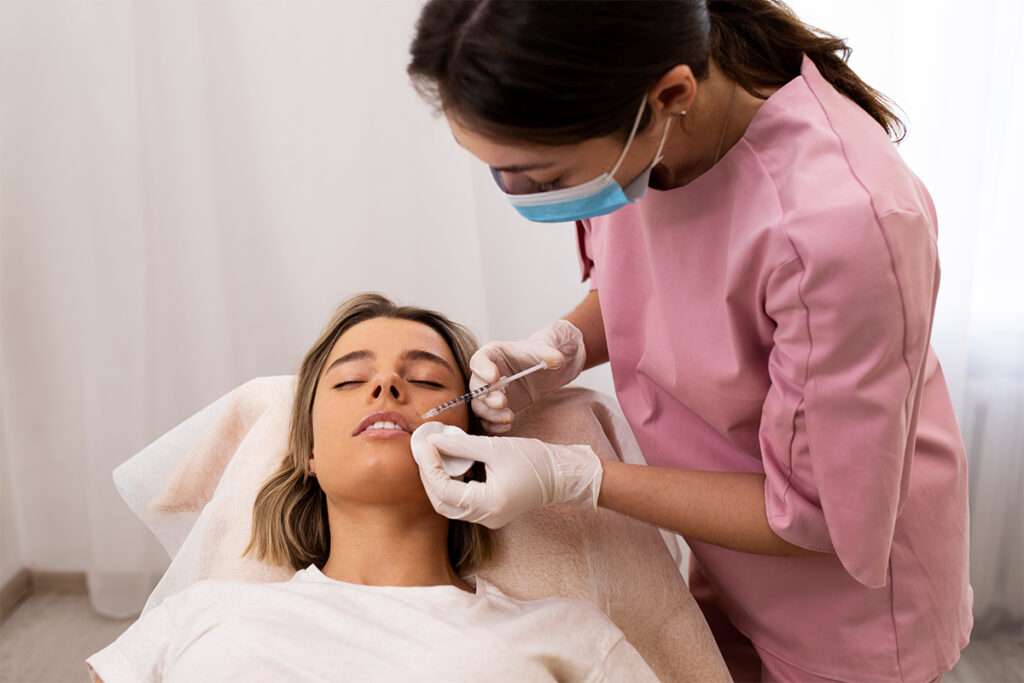
Choosing a cosmetic injector is an important decision. Although treatments such as neuromodulators and dermal fillers are minimally invasive compared with cosmetic surgery, they are still medical procedures that require knowledge of facial anatomy, appropriate treatment planning, injection technique, and patient safety.
With more providers offering cosmetic injectables than ever before, it can be difficult for patients to determine what separates an experienced injector from someone with limited aesthetic training.
Before scheduling an appointment, there are several factors worth considering.
1. Check the Provider’s Medical Credentials
The first step is understanding who will actually perform your treatment.
Depending on the state and the provider’s professional scope of practice, different medical professionals may be qualified to administer cosmetic injectables. Patients should research the provider’s professional credentials, licensing, education, and experience.
A reputable aesthetic practice should be transparent about the qualifications of its injectors.
It is also worth asking who will personally perform the injections rather than assuming that the physician associated with a practice will administer every treatment.
Credentials alone do not guarantee a particular aesthetic outcome, but they are an important starting point when evaluating a provider.
2. Ask About Specialized Aesthetic Training
General medical education and specialized cosmetic injection training are not necessarily the same thing.
Injecting the face requires an understanding of facial anatomy, muscle movement, tissue characteristics, product selection, injection techniques, and aesthetic proportions.
Providers who work extensively with neuromodulators and dermal fillers should have appropriate education and practical experience in these areas.
For medical professionals who want to expand their knowledge of aesthetic injections, structured education can provide an opportunity to study facial anatomy, neuromodulators, dermal fillers, treatment planning, and injection techniques in greater depth.
For example, online neuromodulator and filler training can provide medical professionals with additional educational resources as they develop their understanding of aesthetic medicine.
Patients do not necessarily need to choose an injector based on the number of certificates displayed in an office. However, understanding a provider’s education and ongoing training can help establish how seriously they approach aesthetic medicine.
3. Pay Attention to the Consultation
A good consultation should involve much more than asking which injectable you want.
An experienced injector should take time to understand your goals and evaluate your face before recommending a treatment.
This may involve assessing:
- Facial proportions
- Skin quality
- Muscle movement
- Existing facial volume
- Facial asymmetry
- Previous cosmetic treatments
- Areas that concern you
- Your desired outcome
The provider should also explain whether the treatment you are requesting is appropriate for your individual anatomy.
A patient asking for a particular procedure should not automatically receive that procedure simply because they requested it.
Sometimes the most appropriate recommendation may involve using less product, treating a different area, combining treatments, or postponing treatment altogether.
4. Look for an Individualized Treatment Plan
There is no universal injection map that works perfectly for every face.
Facial anatomy varies considerably between individuals. Age, genetics, bone structure, muscle activity, soft-tissue volume, and previous treatments can all influence the appropriate approach.
This is why experienced injectors often adjust their treatment strategy according to the individual rather than applying exactly the same technique to every patient.
The goal should be to complement the patient’s existing features rather than make every face look the same.
A natural-looking result often depends as much on what an injector chooses not to treat as it does on the areas they decide to treat.
5. Understand the Difference Between Neuromodulators and Fillers
Patients should understand what type of injectable is being recommended and why.
Neuromodulators and dermal fillers work differently.
Neuromodulators temporarily reduce activity in targeted muscles and are commonly used to soften dynamic facial lines. Dermal fillers, depending on the product and indication, can restore or add volume in selected areas.
This distinction is important because the same concern may have different causes.
For example, some lines are primarily related to repetitive muscle movement, while other changes may be associated with volume loss or changes in facial structure.
A qualified injector should be able to explain why a particular treatment is being recommended instead of simply choosing a product because it is popular.
6. Ask Which Product Is Being Used
Patients should know what product is being injected and why it has been selected.
There are multiple neuromodulators and dermal fillers available, and individual products can have different characteristics, indications, and expected durations.
During a consultation, patients should feel comfortable asking:
- What product are you recommending?
- Why is this product appropriate for me?
- What results should I realistically expect?
- How long can the results typically last?
- What are the potential side effects?
- Are there alternatives?
- What happens if I am unhappy with the result?
A knowledgeable provider should be able to answer these questions clearly without making the patient feel uncomfortable for asking.
7. Review Before-and-After Results Carefully
Before-and-after photographs can be useful when researching an injector, but they should be evaluated carefully.
Look for results that address concerns similar to your own rather than simply choosing the most dramatic transformation.
Ideally, photographs should be taken under consistent conditions, including similar lighting, positioning, and facial expression.
It can also be helpful to ask whether the provider has significant experience treating the particular area that concerns you.
A gallery filled with dramatic transformations is not necessarily evidence that the provider’s approach is right for every patient. Subtle and balanced results can require considerable planning and technical skill.
8. Ask About Safety and Potential Complications
Cosmetic injections should be treated as medical procedures rather than ordinary beauty treatments.
Patients should receive appropriate information about potential risks, contraindications, aftercare, and what to do if they experience an unexpected reaction.
The provider should also have appropriate protocols for managing complications.
This is particularly important with dermal fillers. Although serious complications are uncommon, adverse events can occur, which makes appropriate patient selection, anatomical knowledge, injection technique, and complication management important aspects of aesthetic practice.
A provider’s approach to safety should therefore be an important part of the decision-making process.
9. Be Cautious About Unrealistic Promises
Aesthetic medicine is surrounded by marketing claims.
Patients should be cautious when a provider guarantees a particular result, suggests that a treatment has no risks, or claims that one procedure can solve every cosmetic concern.
Good aesthetic medicine involves individualized decision-making.
An ethical provider should be willing to explain the limitations of a treatment and tell a patient when a particular procedure may not be appropriate.
Sometimes saying “no” to a treatment is evidence of good clinical judgment.
10. Don’t Choose an Injector Based Only on Price
Price is naturally part of the decision, but it should not be the only deciding factor.
Two injectable treatments can have different prices because of differences in provider experience, product selection, treatment planning, practice standards, and the level of individualized care involved.
A lower price is not necessarily a better value if the treatment produces an undesirable result or requires correction.
Patients should consider the overall experience, including the provider’s qualifications, consultation process, treatment plan, products, facility, and follow-up care.
The Best Cosmetic Injector Is Not Necessarily the One Who Injects the Most
Ultimately, choosing a cosmetic injector should be about more than the number of procedures a provider performs.
The right provider should combine appropriate medical credentials with specialized aesthetic education, strong anatomical knowledge, thoughtful consultation, realistic communication, and a commitment to patient safety.
A good cosmetic treatment should begin with understanding the patient’s face and goals—not with deciding which syringe to use.
Patients should feel comfortable asking questions and should never feel pressured into a treatment they do not fully understand.
Final Thoughts
Cosmetic injectables can produce subtle and meaningful improvements when they are appropriately selected and carefully administered.
Before choosing an injector, take the time to research the provider’s credentials, aesthetic training, experience, treatment philosophy, and approach to patient safety.
The consultation is ultimately one of the best opportunities to determine whether an injector is the right fit.
A knowledgeable provider should be willing to explain the treatment, discuss realistic expectations, answer questions, and recommend an approach based on the patient’s individual anatomy and goals.