
Table of Contents
- What Is a Cosmetic Injector?
- How to Become a Cosmetic Injector
- 1. Start With the Right Healthcare Credentials
- 2. Choose the Right Cosmetic Injector Training
- Beginner Cosmetic Injector Training
- 3. Learn Botox and Neuromodulator Injection Techniques
- 4. Learn Dermal Filler Techniques
- 5. Consider Hands-On Cosmetic Injection Training
- 6. Can You Become a Cosmetic Injector Online?
- 7. Understand Cosmetic Injector Certification
- 8. Look for CME and Accredited Education
- 9. Develop Skills in Complication Management
- 10. Choose Training Based on Your Experience Level
- If You Are Completely New to Aesthetic Injections
- If You Already Have Injection Experience
- If You Need Flexible Education
- Cosmetic Injector Training for Nurses
- How Long Does It Take to Become a Cosmetic Injector?
- What Should You Look for in a Cosmetic Injector Course?
- Is Cosmetic Injector Training Worth It?
- Common Questions About Becoming a Cosmetic Injector
- How do I become a Botox injector?
- Start Your Cosmetic Injector Training
- Final Thoughts
- Related links
If you are a licensed healthcare professional interested in medical aesthetics, becoming a cosmetic injector can be a way to expand your clinical skills and add aesthetic services to your professional practice.
But learning how to become a cosmetic injector involves more than simply learning how to inject Botox or dermal fillers. Proper training can include facial anatomy, patient assessment, product knowledge, injection techniques, complication management, hands-on practice, and continuing education.
This guide explains the general pathway to becoming a cosmetic injector and how professional training and certification can fit into that process.
What Is a Cosmetic Injector?
A cosmetic injector is a qualified healthcare professional who performs non-surgical aesthetic treatments such as neuromodulator injections and dermal filler procedures.
Depending on the provider’s professional license, training, scope of practice, and applicable regulations, cosmetic injectors may work with treatments involving:
- Botox and other neuromodulators
- Dermal fillers
- Lip enhancement
- Chin and jawline enhancement
- Facial contouring
- Other non-surgical aesthetic treatments
Because injectable treatments involve clinical assessment and medical decision-making, appropriate education and professional credentials are important.
AACM™’s programs are designed for licensed healthcare professionals, including physicians, dentists, registered nurses, nurse practitioners, and physician assistants. Always verify the licensing and scope-of-practice requirements applicable in your jurisdiction before providing aesthetic treatments.
How to Become a Cosmetic Injector
The path to becoming a cosmetic injector generally involves several stages:
- Obtain an appropriate healthcare credential.
- Verify your eligibility to practice aesthetic medicine in your jurisdiction.
- Complete cosmetic injector training.
- Develop knowledge of facial anatomy and injectable products.
- Gain supervised hands-on experience where available and appropriate.
- Complete any required examinations or certification requirements.
- Continue developing your clinical knowledge and injection skills.
The exact requirements can vary depending on your profession, location, employer, and applicable regulations.
For healthcare professionals looking for structured education, a dedicated cosmetic injector training and certification program can provide a more organized pathway into aesthetic medicine.
1. Start With the Right Healthcare Credentials
Cosmetic injection training is generally intended for licensed healthcare professionals rather than individuals without a medical credential.
AACM™ currently lists physicians, dentists, registered nurses, nurse practitioners, and physician assistants among the healthcare professionals eligible for its courses.
Before enrolling in training, determine:
- Whether your professional license permits you to perform aesthetic injections
- Whether physician supervision or collaboration is required
- Whether additional state or local requirements apply
- Whether your employer has specific credentialing requirements
- What documentation is required before providing injectable treatments
These requirements can differ significantly between jurisdictions.
Training is an important part of becoming an injector, but completing a course does not automatically change the legal scope of practice associated with a healthcare license.
2. Choose the Right Cosmetic Injector Training
One of the most important steps in learning how to become a cosmetic injector is selecting appropriate training.
A strong educational program should go beyond simply demonstrating where to place an injection.
Look for education covering areas such as:
- Facial anatomy
- Patient consultation
- Facial assessment
- Neuromodulators
- Dermal fillers
- Injection techniques
- Product selection
- Patient expectations
- Complication management
- Treatment planning
- Clinical safety
- Hands-on practice
- Continuing education
AACM™ offers different education pathways depending on a provider’s experience level.
Beginner Cosmetic Injector Training
Healthcare professionals who are new to aesthetic injections may benefit from foundational education before moving into more complex procedures.
AACM™’s Beginner Aesthetic Injection Course is designed for providers with little or no cosmetic injection experience.
The current beginner program includes hands-on training involving neuromodulators and dermal fillers, with a minimum of four neuromodulator injections and four filler injections in different facial areas.
The curriculum also covers facial functional anatomy, product fundamentals, treatment indications, injection points, patient preparation, and other foundational concepts.
3. Learn Botox and Neuromodulator Injection Techniques
Botox is one of the most commonly recognized aesthetic injectable treatments, but becoming a Botox injector requires more than memorizing injection points.
A quality Botox injector training program should help providers understand:
- Facial anatomy
- Muscle function
- Patient assessment
- Treatment planning
- Product preparation
- Injection technique
- Appropriate treatment areas
- Patient expectations
- Potential adverse effects
- Follow-up considerations
AACM™’s training programs cover neuromodulators alongside dermal fillers, allowing students to learn both categories of injectable treatments.
If you are specifically researching Botox certification and injector training, AACM™ provides information about its certification pathway and FAACM® credential.
4. Learn Dermal Filler Techniques
Dermal fillers require a different understanding of facial anatomy and product characteristics.
Depending on the course and provider’s level of experience, filler education can include treatment planning for areas such as:
- Lips
- Chin
- Cheeks
- Jawline
- Temples
- Nasolabial folds
- Other facial areas
More advanced filler education may also address complex facial anatomy, patient asymmetry, cannula considerations, and management of complications.
AACM™’s Advanced Botox and Filler Training is designed for providers who already have some experience or knowledge of cosmetic injections. The current comprehensive course includes advanced neuromodulator and filler injection areas.
5. Consider Hands-On Cosmetic Injection Training
Online education can be convenient, but injection skills also involve practical application.
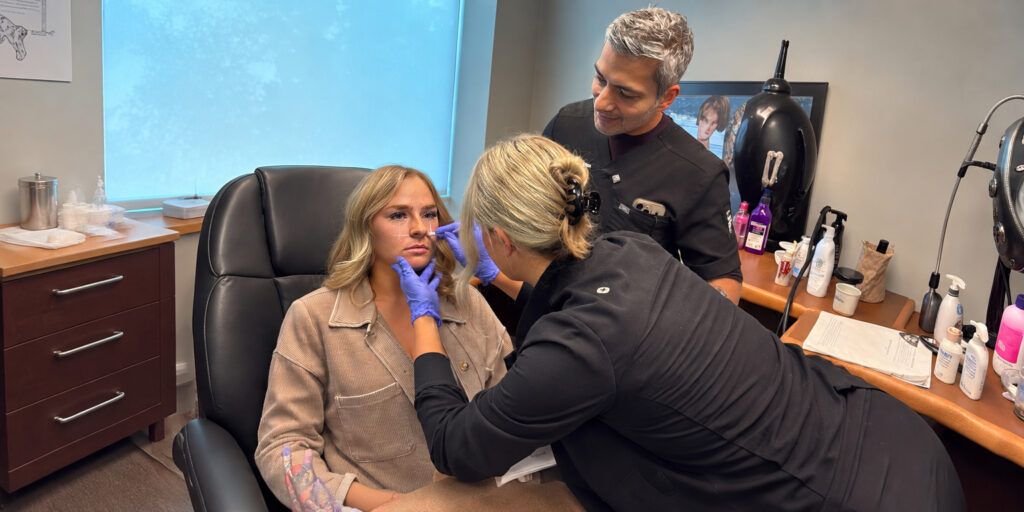
For healthcare professionals who want supervised clinical experience, hands-on training can provide an opportunity to observe experienced injectors and practice techniques in an appropriate educational setting.
AACM™ provides hands-on Botox training opportunities that can be taken independently or added to certain Botox and filler education pathways.
Hands-on training can help providers work through questions that are difficult to fully understand from written material alone, including:
- Patient positioning
- Facial assessment
- Injection approach
- Treatment planning
- Clinical workflow
- Communication with patients
- Product preparation
- Real-world treatment considerations
For new injectors, combining theoretical education with appropriate supervised practical experience can be particularly valuable.
6. Can You Become a Cosmetic Injector Online?
Yes, online education can be part of a cosmetic injector training pathway, but the exact requirements depend on the program, provider, and jurisdiction.
Online training can be particularly useful for healthcare professionals who need flexibility around their existing clinical schedule.
AACM™’s current online Botox and filler training provides self-paced educational content with 180 days of access. The program includes approximately 8.5 hours of course material and an opportunity for clinical shadowing.
Online education can cover important theoretical areas such as:
- Facial anatomy
- Neuromodulators
- Dermal fillers
- Patient assessment
- Injection techniques
- Complication management
- Clinical considerations
- Aesthetic practice fundamentals
However, providers should understand the difference between learning the theory of injections and developing practical injection skills.
If hands-on experience is important for your learning goals, look for a program that offers an appropriate practical or clinical component.
7. Understand Cosmetic Injector Certification
Another common question is:
Do you need certification to become a cosmetic injector?
The answer depends on your profession, jurisdiction, employer, and applicable regulations.
Certification and professional licensure are not necessarily the same thing.
A healthcare license establishes your professional scope of practice, while a training certificate or professional certification can document additional education and competency requirements.
AACM™ describes a certification pathway involving completion of an approved course and additional certification requirements. Its certification information explains the pathway to the FAACM® (Fellow of the American Academy of Cosmetic Medicine®) designation.
You can learn more about the distinction and AACM™’s process through the AACM™ Botox certification guide.
8. Look for CME and Accredited Education
Continuing medical education can be another consideration when comparing aesthetic injection courses.
AACM™ states that its qualifying programs can provide eligibility for 8.5 CME credits and describes accreditation/recognition involving organizations including ACCME, ACPE, ANCC, and ADA CERP.
Healthcare professionals should always confirm that a specific course meets their own professional or licensing requirements.
You can review AACM™’s accreditation and continuing education information before selecting a course.
9. Develop Skills in Complication Management
Cosmetic injectables are medical procedures, so training should address more than achieving aesthetic results.
Providers should understand the importance of:
- Patient screening
- Medical history
- Contraindications
- Informed consent
- Appropriate treatment planning
- Recognizing complications
- Managing adverse events
- Knowing when additional medical evaluation is required
- Appropriate follow-up
AACM™’s course information specifically identifies complication management and clinical care as part of its educational resources and instructor support.
This is one reason why choosing a comprehensive medical aesthetics training program can be more useful than relying exclusively on short technique demonstrations.
10. Choose Training Based on Your Experience Level
Not every cosmetic injector needs the same type of course.
If You Are Completely New to Aesthetic Injections
A beginner course may be appropriate.
Look for:
- Facial anatomy fundamentals
- Neuromodulator fundamentals
- Filler fundamentals
- Patient assessment
- Basic injection techniques
- Supervised hands-on experience
AACM™’s beginner cosmetic injector course is specifically designed for providers with little or no experience.
If You Already Have Injection Experience
An advanced or comprehensive program may be more appropriate.
Advanced education can cover:
- More complex facial anatomy
- Advanced neuromodulator treatment areas
- Advanced filler techniques
- Facial asymmetry
- Cannula techniques
- Complication management
- Patient expectations
AACM™’s comprehensive Botox and filler training is intended for providers with some existing experience or knowledge.
If You Need Flexible Education
An online course may fit better around an existing clinical schedule.
AACM™’s online Botox and dermal filler course is self-paced with 180 days of access.
Cosmetic Injector Training for Nurses
Registered nurses and advanced practice nurses are among the healthcare professionals who may pursue aesthetic injection education, subject to their applicable licensing and scope-of-practice requirements.
AACM™ offers resources specifically relevant to healthcare professionals interested in aesthetic medicine, including aesthetic nurse practitioner training.
Nurses considering an aesthetic career should evaluate:
- Their state licensing requirements
- Employer requirements
- Supervision requirements
- Appropriate cosmetic injection education
- Hands-on training opportunities
- Certification options
- Continuing education
How Long Does It Take to Become a Cosmetic Injector?
There is no single timeline that applies to every healthcare professional.
Your timeline can depend on:
- Your existing healthcare credentials
- Previous injection experience
- The training program you select
- Whether you choose online or in-person education
- Whether hands-on training is included
- Examination or certification requirements
- Your local professional regulations
For example, AACM™ currently describes its beginner program as a 10-hour course, its comprehensive program as a 20-hour course, and its online program as approximately 8.5 hours of educational content with 180 days of access.
The educational course length, however, should not be confused with the total time required to become confident and competent in aesthetic practice.
What Should You Look for in a Cosmetic Injector Course?
Before enrolling, compare programs based on the quality and depth of their education rather than looking only at price.
Consider whether the program includes:
1. Qualified Instructors
Look for instructors with relevant clinical and aesthetic experience.
2. Facial Anatomy Education
Understanding anatomy is fundamental to planning injectable treatments.
3. Botox and Neuromodulator Training
The course should explain both the theory and practical considerations behind neuromodulator treatments.
4. Dermal Filler Training
Look for education covering different filler applications and treatment planning.
5. Hands-On Opportunities
Practical training can complement online and classroom education.
6. Complication Management
The course should address safety, adverse events, and appropriate clinical responses.
7. Certification Information
Understand exactly what certificate or credential you receive and what it represents.
8. Continuing Education
Look for programs that support ongoing learning after the initial course.
9. Flexible Learning Options
Self-paced online education can be useful for busy medical professionals.
AACM™’s cosmetic injector courses and certification programs include beginner, comprehensive, and online training options.
Is Cosmetic Injector Training Worth It?
For a healthcare professional considering aesthetic medicine, formal training can provide a structured way to develop knowledge that may otherwise take much longer to organize independently.
A comprehensive program can bring multiple areas of education together, including:
- Anatomy
- Product knowledge
- Injection techniques
- Patient consultation
- Safety
- Complication management
- Hands-on practice
- Clinical observation
- Professional development
The value of any course ultimately depends on your professional goals, existing experience, the quality of instruction, and whether the program meets the requirements relevant to your practice.
Common Questions About Becoming a Cosmetic Injector
Licensed nurses may be eligible for cosmetic injection training, depending on their professional license and jurisdiction. AACM™ lists RNs and NPs among the healthcare professionals eligible for its courses.
Review your applicable scope-of-practice rules before performing injectable treatments.
Yes, nurse practitioners can pursue aesthetic injection education, subject to applicable licensing and practice requirements.
AACM™ provides aesthetic nurse practitioner training for professionals interested in this area.
Physicians can pursue specialized cosmetic injection education to develop their knowledge and skills in aesthetic medicine.
Training can be particularly useful for physicians who are adding aesthetic procedures to an existing practice.
Physician assistants may also be eligible for cosmetic injector education, depending on applicable licensing and scope-of-practice requirements. AACM™ lists PAs among the healthcare professionals eligible for its programs.
Online Botox education can provide theoretical and instructional training, but providers should also consider practical experience and appropriate supervised training.
AACM™’s online course combines self-paced education with an opportunity for clinical shadow
How do I become a Botox injector?
A typical pathway is to:
- Hold an appropriate healthcare credential.
- Confirm your legal scope of practice.
- Complete Botox and aesthetic injection training.
- Learn facial anatomy and patient assessment.
- Gain appropriate practical experience.
- Complete applicable examinations or certification requirements.
- Continue developing your skills through education and clinical experience.
Start Your Cosmetic Injector Training
Becoming a cosmetic injector is a professional development process that combines healthcare credentials with specialized aesthetic education.
Whether you are completely new to cosmetic injections or already performing aesthetic treatments, choosing education that matches your experience level is an important step.
AACM™ offers beginner aesthetic injection training, comprehensive Botox and filler training, and online Botox and dermal filler training for eligible healthcare professionals.
If you are ready to explore your options, review the AACM™ cosmetic injector courses and choose the training format that aligns with your professional background, experience level, and career goals.
Final Thoughts
Learning how to become a cosmetic injector involves much more than learning where to place Botox or dermal filler.
The strongest foundation combines appropriate healthcare credentials, structured aesthetic education, facial anatomy knowledge, patient assessment, injection training, practical experience, safety education, and continued professional development.
For beginners, foundational training can provide the starting point. Experienced providers may benefit from comprehensive or advanced education. Online courses can provide flexibility, while hands-on training can add practical clinical experience.
Before enrolling in any cosmetic injection course, confirm that the program is appropriate for your professional background and that you understand the licensing and scope-of-practice requirements that apply where you intend to practice.