


Estimated reading time: 8 minutes
Key Takeaways
- When selecting a Botox training program, consider both hands-on and didactic training options to build practical skills and theoretical knowledge.
- A Botox certification course does not automatically grant legal permission to inject; state laws and professional licensing remain vital.
- Evaluate course details like supervised practice, instructor qualifications, and post-course support before enrolling in Botox training.
- AACM™ offers various Botox training options for licensed healthcare professionals, providing both foundational and practical instruction opportunities.
- Understanding your own educational needs will help determine which Botox training format best suits you.
Choosing a Botox injection class is not only about finding a course that offers certification. The bigger question is what kind of training will actually help a healthcare professional build the knowledge and practical skills needed for aesthetic injections.
A course may offer hours of online lessons, while another may spend more time in a classroom or clinical setting. Some programs combine both. The right choice can depend on prior clinical experience, comfort with injections, schedule, and the amount of supervised practice the course provides.
For anyone comparing a Botox certification course, it also helps to look beyond the course format. A strong program should cover facial anatomy, patient assessment, treatment planning, injection principles, and safety rather than focusing only on where the lessons take place.
For licensed healthcare professionals considering aesthetic medicine, AACM™ offers Botox and filler training with both educational and hands-on options. The program can be explored through its Botox training and certification courses.
Difference Between Hands-On and Didactic Botox Training
The difference comes down to learning the knowledge versus putting it into practice. Didactic training builds the clinical foundation, while hands-on training allows learners to apply that knowledge under instructor guidance.
| Hands-On Training | Didactic Botox Training |
| Learn through supervised practice | Learn through lessons, videos, and lectures |
| Practice injection techniques | Study anatomy, treatment planning, and safety |
| Get direct instructor feedback | Review and revisit lessons as needed |
| Connect theory with real clinical situations | Build the knowledge behind each treatment |
| Focus on practical skills and confidence | Focus on understanding and clinical reasoning |
In simple terms, didactic training explains what and why, while hands on training focuses on applying that knowledge in practice.
Is Hands-On Botox Training Better Than Online Training?
Not necessarily.
Online didactic education can make it easier to study anatomy, treatment principles, and safety information at a convenient pace. A learner can pause a lesson, review difficult material, and return to a topic before moving forward.
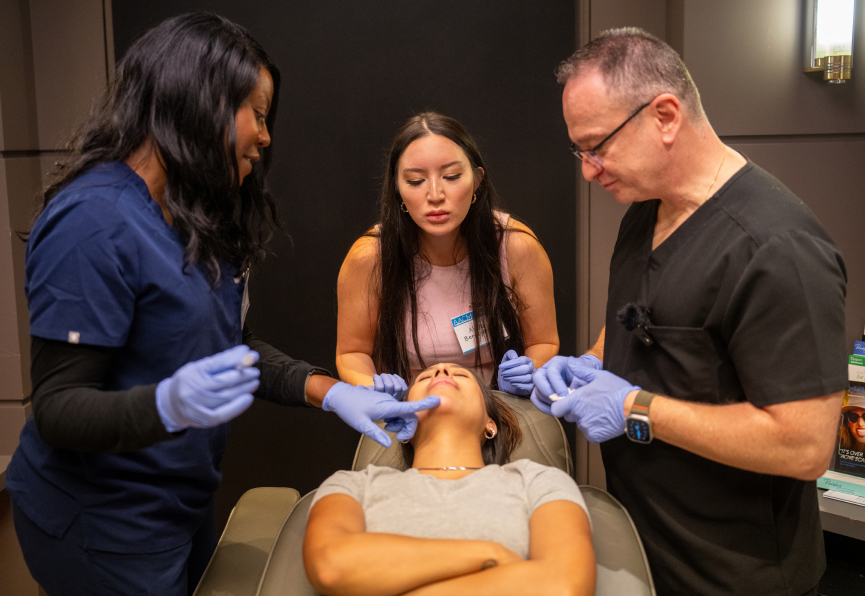
Hands-on education addresses a different need. It provides learners with a setting in which an instructor can demonstrate technique and offer practical feedback.
The strongest choice may therefore depend on what is missing from an individual’s current training.
For someone with strong clinical experience but limited aesthetic education, a detailed didactic foundation may be particularly useful. For someone who already understands the theory but needs supervised practical experience, hands-on training may fill the larger gap.
A blended model can combine both. Current aesthetic training programs commonly offer online learning, in-person instruction, or a combination of the two.
Do New Injectors Need Hands On Botox Training?
There is no single format that fits every healthcare professional.
Someone new to aesthetic injections may benefit from a program that teaches the basics of the theory and then provides supervised practical experience. The combination can help connect facial anatomy and treatment planning with actual clinical technique.
A healthcare professional who already performs injections in another clinical setting may have different educational needs. More time may be better spent on aesthetic assessment, facial anatomy, product knowledge, and treatment planning rather than on basic needle handling.
For an experienced aesthetic injector seeking to improve a specific area, a focused, hands-on workshop may make more sense than repeating an entire introductory curriculum.
Schedule also matters. An online course may fit more easily around clinical work, while an in-person program requires time away from regular responsibilities.
The better question is not “Which learning style am I?”
It is:
“What part of my clinical education needs the most development?”
That question leads to a more useful comparison of courses.
What Should Be Considered Before Choosing a Botox Injection Class?
A course certificate alone does not tell the full story.
The curriculum should show what learners will actually study. Instructor background also matters, particularly when the course involves practical injection training.
It is worth checking whether the program includes supervised practice, how many learners attend each practical session, whether safety and complication management receive meaningful attention, and what support remains available after the course.
CME can also matter for healthcare professionals who need continuing education. The American Medical Association notes that accredited CME activities are designed to support physician knowledge, skills, and competence. However, the value and requirements depend on the specific activity and professional license.
A certificate should not be confused with a professional license or independent permission to perform injections. Scope of practice depends on the healthcare professional’s credentials and applicable state rules.
Does Botox Certification Mean Someone Can Legally Inject?
No single certification rule applies to every healthcare professional in every state.
A Botox certification course provides education and documentation of course completion. It does not replace a professional license or automatically expand a practitioner’s legal scope of practice.
The requirements can depend on the practitioner’s profession, state law, employer, supervising physician arrangements, and practice setting.
For that reason, legal questions about who may administer cosmetic injections should be checked with the appropriate state licensing authority rather than answered with a blanket statement.
This distinction is especially important for nurses, nurse practitioners, physician assistants, physicians, and dentists because their legal requirements may differ.
What Should Be Checked Before Enrolling in a Botox Course?
Course titles can make programs look similar even when the actual training differs. A closer look at the curriculum can reveal important differences.
Ask:
- Who teaches the course?
- What topics does the curriculum cover?
- How much hands on instruction is included?
- Do learners perform injections or only observe?
- Is practical training supervised?
- How large are the practical groups?
- What does the certificate represent?
- Is CME available?
- What support is available after the course?
- Does the course match the learner’s current experience level?
These questions can provide more useful information than comparing course length alone.
How AACM™ Approaches Botox Injection Training
AACM™ offers Botox and filler education for licensed healthcare professionals through different training formats and course levels.
Its training options include educational material covering foundational topics as well as hands on instruction for neuromodulator and filler treatments. AACM™ states that its beginner training includes facial anatomy and practical training, while its comprehensive option provides additional instruction for healthcare professionals seeking more advanced education.
AACM™ also states that its courses are intended for licensed healthcare professionals, including RNs, NPs, PAs, physicians, and dentists, with a medical license required for enrollment.
Choosing the Right Botox Training at AACM™
The right Botox course should match the skills and knowledge that still need development. A new injector may need both foundational education and supervised practice, while an experienced clinician may benefit more from focused hands on training.
For licensed healthcare professionals exploring aesthetic education, AACM™’s Botox and filler training options offer different levels of foundational and hands on instruction.
FAQs
Hands-on and online training serve different purposes. Online education can build knowledge in areas such as anatomy and treatment planning, while supervised practical training can help develop injection skills. The more useful format depends on prior experience and the gaps in a learner’s current training.
Didactic Botox training focuses on the knowledge behind aesthetic injections. It may cover facial anatomy, principles of botulinum toxin, patient assessment, treatment planning, safety, and product information.
Hands-on education may be useful for healthcare professionals new to aesthetic injections, as it offers the opportunity to observe techniques and receive direct feedback. The amount and type of practical training needed can vary based on prior clinical experience.
A well-rounded course should address more than just injection locations. Facial anatomy, patient assessment, treatment planning, product knowledge, safety, and practical technique are important areas to examine when comparing programs.
A hybrid course can combine the flexibility of online learning with practical instruction. Its value depends on how much meaningful instruction and supervised practice the program provides.
Course length varies widely. Some programs use a short online course, while others combine online education with one or more days of practical instruction. The number of hours alone does not determine botox course quality.
Certification from a training provider does not replace a professional license or automatically change a practitioner’s scope of practice. Applicable state laws and professional rules still apply.
Eligibility varies by training provider. AACM™ currently states that its courses are intended for licensed healthcare professionals, including RNs, NPs, PAs, physicians, and dentists.