
Table of Contents
- Key Takeaways
- Who Can Become a Botox Injector?
- What Are the Steps to Become a Certified Botox Injector?
- What Does an Accredited Botox Course Cover?
- Can You Get Botox Certified Through an Online Botox Course?
- How Do You Earn Botox Certification and the FAACM® Designation?
- What Career Opportunities Open Up After Botox Certification?
- Why Does Training From a Certified Plastic Surgeon Matter?
- Ready to Start Your Career in Aesthetic Medicine?
- Frequently Asked Questions
- Related Links
Estimated reading time: 7 minutes
Key Takeaways
- Botox is the most popular nonsurgical cosmetic treatment, requiring trained providers to meet high demand.
- Licensed medical professionals—like physicians, nurses, and dentists—can qualify to become Botox injectors.
- Becoming a certified Botox injector involves completing an accredited course, passing an exam, and gaining practical experience.
- AACM™ offers both online and in-person Botox courses that provide hands-on training and mentorship.
- Certification opens up diverse career opportunities in aesthetic medicine and typically leads to higher earning potential.
Botox is the most requested nonsurgical cosmetic treatment in the United States, and clinics, med spas, and private practices need trained providers to meet that demand. The fastest and most reliable path to become a Botox injector is a CME-accredited Botox course through the American Academy of Cosmetic Medicine® (AACM™), which trains licensed medical professionals through online and in-person programs based in Washington state.
This blog covers who qualifies, what training involves, how certification works, and what career options open up once you finish.
Who Can Become a Botox Injector?
Botox is a prescription medication, so the person administering it must hold a valid medical license. You qualify for Botox certification training if you are a:
- Physician (MD or DO) — able to inject and oversee aesthetic practices
- Dentist (DDS or DMD) — well positioned given deep training in facial anatomy
- Registered Nurse (RN) — able to inject under appropriate supervision in most states
- Nurse Practitioner (NP) — often able to practice with greater independence
- Physician Assistant (PA) — able to inject and, in some states, open independent practices
AACM™ accepts qualified medical professionals and students from around the world, offering options for both in-person instruction and a 100% online Botox course.
What Are the Steps to Become a Certified Botox Injector?
The pathway from licensed medical professional to certified injector follows five steps:
- Hold an active medical license as a physician, dentist, RN, NP, or PA
- Verify your state’s regulations for administering cosmetic injectables
- Complete an accredited Botox course with hands-on or virtual technique training
- Pass the written certification exam at the end of your program
- Begin practicing with ongoing mentorship and clinical support
Most professionals complete this process in days to weeks, depending on the training format they choose.
What Does an Accredited Botox Course Cover?
Every AACM™ training program includes 8.5 CME credits, is jointly accredited by the AMA, ACCME, ACPE, ANCC, and ADA, and is planned in collaboration with the Postgraduate Institute for Medicine. Students can choose between two training pathways depending on their schedule and learning preferences: a fully 100% online program or hands-on, in-person training in Washington state.
The online Botox course is an 8.5-hour program completed entirely at your own pace within 180 days. The curriculum includes virtual demonstrations of advanced injection techniques for both neuromodulators and dermal fillers, along with coverage of advanced procedures. To bridge the gap between digital learning and live patient care, every online student also receives three free clinical shadow days. For working nurses, PAs, and physicians balancing full schedules, this format removes the biggest barrier to entering aesthetic medicine.
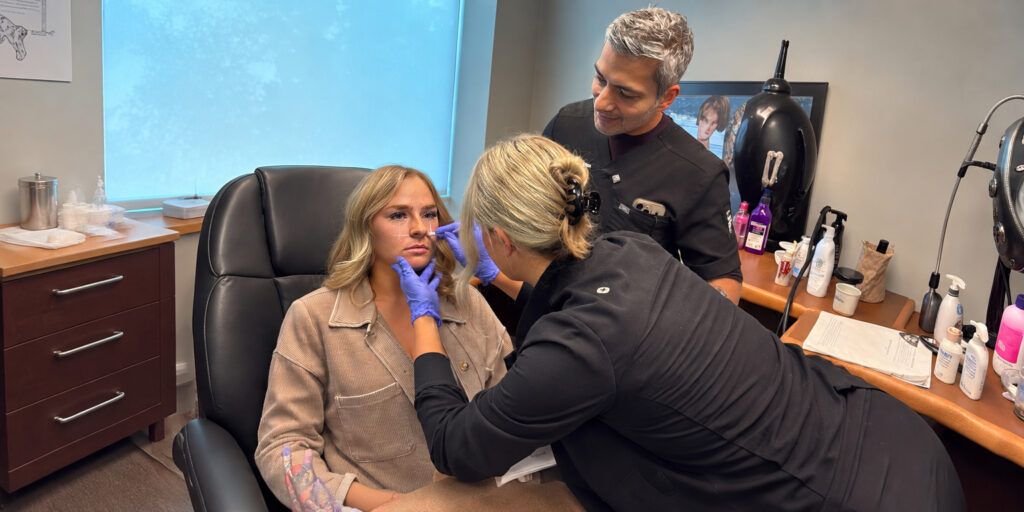
For those who choose hands-on instruction, the in-person beginner course is a 10-hour, one-day program held in Washington state. Students learn to inject the full range of neuromodulators, including Botox, Dysport, Daxxify, Xeomin, Jeuveau, and Letybo, along with hyaluronic acid fillers in the lips and cheeks. Each student practices a minimum of four injection areas for neuromodulators and four for fillers, ensuring real technique repetition rather than observation alone. The program also includes four live shadow days for genuine clinical exposure.
In-Person Comprehensive Course
The in-person comprehensive course expands on the beginner curriculum with a 20-hour, two-day program. In addition to all beginner content, students learn advanced procedures such as hyperhidrosis, lip flips, platysmal bands, and migraine therapy. Filler training goes beyond the lips and cheeks to include the nasolabial folds, temples, and under-eye area, and students obtain hands-on experience with live plasma harvesting, centrifuging, and injecting. The comprehensive track includes five live shadow days, the most of any AACM™ program.
Can You Get Botox Certified Through an Online Botox Course?
Yes. An online Botox course is a legitimate option for licensed medical professionals who cannot travel for in-person training. AACM™’s online pathway delivers the full 8.5-hour curriculum digitally, completed within 180 days, and includes virtual demonstrations of advanced injection techniques.
The online program also comes with three free clinical shadow days, which bridge the gap between digital learning and live patient care. For working nurses, PAs, and physicians balancing full schedules, this leeway removes the biggest barrier to entering aesthetic medicine.
How Do You Earn Botox Certification and the FAACM® Designation?
Each AACM™ course concludes with a written exam. Graduates who pass earn AACM™ certification and the right to use the FAACM® designation after their name, an accreditation that signals accredited training to employers and patients.
Two paths lead to certification:
- Standard pathway: complete a course and pass the written exam
- Experience pathway: experienced injectors pass the written exam and submit photos of three or more completed injectable treatments
Certified students also receive 24/7 access to AACM™’s lead instructors for ongoing clinical guidance. That mentorship matters most in the first months of practice, when new injectors face real patient questions without a classroom safety net.
What Career Opportunities Open Up After Botox Certification?
Certification creates multiple career paths across aesthetic medicine:
- Nurses and NPs — positions at med spas, dermatology offices, and plastic surgery practices, often with higher earning potential than traditional clinical roles
- Physician assistants — independent aesthetic practices in states that permit it
- Physicians and dentists — injectables as a new revenue stream within an existing practice, retaining patients who would otherwise seek treatment elsewhere
The U.S. medical aesthetics market continues to expand year over year, which means certified injectors enter a field with strong long-term demand and room for growth.
Why Does Training From a Certified Plastic Surgeon Matter?
What separates AACM™ from standard weekend seminars is who teaches the material. Instruction comes from a certified plastic surgeon and accomplished injector who has personally trained many injectors and tailors technique to each patient. The approach treats injecting as both a science and an art, grounded in facial anatomy and developed through daily clinical work.
The academy also maintains a low student-to-instructor ratio designed for one-on-one, hands-on instruction. Small class sizes mean each student obtains direct feedback on injection depth, angle, and dosing rather than watching from the back of a crowded room.
Ready to Start Your Career in Aesthetic Medicine?
If you are a licensed physician, dentist, RN, NP, or PA, the fastest route into this growing field is accredited training with hands-on practice, real mentorship, and a recognized credential. The best way to become a Botox injector is through a course with the American Academy of Cosmetic Medicine®. Contact the institute and start your online course today.
Frequently Asked Questions
For licensed medical professionals, training can be completed in as little as one day for the in-person beginner course or up to 180 days at your own pace through the online pathway. The bulk of the timeline is the medical licensure you already hold.
Pricing varies by program format and level. Contact AACM™ directly for current tuition, as accredited programs with hands-on training and shadow days are priced differently than lecture-only seminars.
Earnings depend on credentials, location, and practice setting. Aesthetic injectors frequently out-earn peers in traditional clinical roles, and physicians or dentists who add injectables often see meaningful practice revenue growth. Independent practitioners in permissive states have the highest ceiling.
No. Because Botox is a prescription medication, only licensed medical professionals such as physicians, dentists, RNs, NPs, and PAs may administer it, subject to state law. Estheticians and medical assistants do not qualify in any U.S. state.
Yes. Injectors should carry professional liability coverage that specifically includes aesthetic procedures, since standard clinical policies do not always cover cosmetic injectables. Employers may provide coverage, but independent injectors need their own policy.
CME credits and best practices in aesthetic medicine evolve, so injectors should pursue continuing education to stay current with new products, techniques, and safety standards. Ongoing instructor access, like the 24/7 support AACM™ provides, helps certified injectors keep skills sharp.
Technically, some seminars issue certificates, but short lecture-based events rarely include supervised hands-on practice, shadow days, or exam-based certification. Accredited programs with live injection practice produce safer, more confident injectors and stronger career outcomes.