


Estimated reading time: 11 minutes
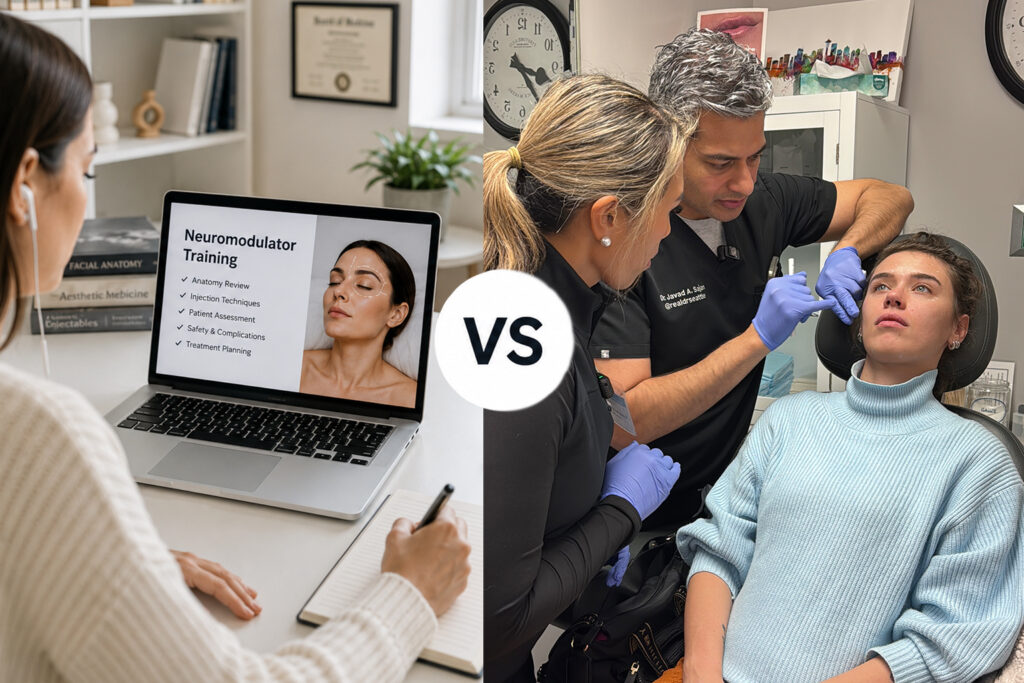
The demand for aesthetic treatments continues to grow, creating new opportunities for physicians, nurses, nurse practitioners, physician assistants, and dentists who want to expand their skills and services. As more medical professionals enter the field, one question comes up repeatedly: Should you choose online Botox training, hands-on training, or a combination of both?
Each learning format offers different advantages. Online courses accommodate busy schedules, while hands-on training builds confidence through supervised patient experience. Hybrid programs combine the convenience of online learning with practical clinical instruction.
The American Academy of Cosmetic Medicine® (AACM™) offers accredited training across all three formats, from fully online certification to comprehensive hands-on courses. AACM™ programs illustrate what medical professionals can expect from quality aesthetic medicine education.
What Does Aesthetic Medicine Online Course Include?
Online botox training has evolved significantly in recent years. Quality programs now deliver comprehensive theoretical education that genuinely prepares medical professionals for clinical practice.
Facial Anatomy: Students learn which muscles produce specific facial expressions, how these muscles interact during movement, and where safe injection zones are located. This anatomical foundation is essential for proper injection placement and the avoidance of complications.
Aging Process: Medical professionals learn how facial structures change over time, including patterns of volume loss, changes in skin quality, and gravitational effects across different facial zones. Understanding these patterns helps injectors develop treatment plans addressing root causes rather than surface symptoms.
Product Knowledge: Online training covers the full range of neuromodulators available today, including Botox, Dysport, Daxxify, Xeomin, Jeuveau, and Letybo. Each product has unique characteristics that affect onset time, diffusion patterns, and the duration of results.
Dermal Filler: Typically, it accompanies neuromodulator training, as these treatments often complement each other. Courses cover hyaluronic acid fillers such as Restylane and Juvederm, explaining their formulations and ideal applications for the lips, cheeks, nasolabial folds, and other treatment areas.
Safety protocols and complication management theory round out comprehensive online programs. Students learn to recognize early warning signs of problems, understand vascular anatomy to avoid dangerous injection zones, and develop response protocols for various complications.
What Does Online Aesthetic Medicine Training Actually Cover?
Online botox training has evolved significantly over the past few years. Modern courses go far beyond basic PowerPoint presentations. They deliver comprehensive theoretical foundations that medical professionals can study at their own pace.
A well-structured online aesthetic medicine course typically covers facial anatomy as it relates to cosmetic injections. Students learn about the aging process and how neuromodulators and dermal fillers can help address visible signs of aging.
Dermal filler education forms another core component. Courses explain the properties of hyaluronic acid fillers like Restylane and Juvederm, covering when and where each product works best.
Safety protocols receive heavy emphasis in quality online programs. Students learn about potential complications, contraindications, and emergency management strategies. Patient consultation techniques, treatment planning approaches, and even business development for aesthetic practices often round out the curriculum.
AACM™ Online Course Structure
The American Academy of Cosmetic Medicine® offers an 8.5-hour online course that students can complete over 180 days. This flexible timeline works well for busy medical professionals juggling existing practices and personal commitments.
Upon completion, graduates earn 8.5 CME Credits recognized by major accrediting bodies including ACCME, ACPE, ANCC, and ADA CERP. This multi-accreditation is actually quite rare in the aesthetic training industry.
The online pathway includes board certification and authorization to use the FAACM® credential after successful completion. Students also receive optional 3-day clinical shadowing, which bridges the gap between theory and practice.
One standout feature involves 24/7 access to expert instructors Dr. Sajan. This ongoing support means graduates never feel alone when facing challenging cases or questions in their practice.
The current investment is $199, significantly discounted from the original $1,500 price.
What Makes Hands-On Aesthetic Training Different?
In-person Botox and filler training offers something that screens simply cannot replicate: tactile experience with real patients under expert supervision.
During hands-on courses, students physically perform injections while instructors provide immediate feedback. They learn to feel the resistance of different tissue planes, gauge needle depth by direct sensation, and develop muscle memory for proper technique.
Live patient training allows students to observe natural anatomical variations. Every face presents differently, and hands-on experience helps providers recognize these differences before they begin independent practice.
Product preparation and handling become second nature through physical practice. Students learn proper dilution techniques for neuromodulators, syringe handling for fillers, and sterile technique protocols.
Facial marking and injection point selection translate from textbook knowledge to practical skill. Instructors demonstrate their approaches, then guide students through the process on actual patients.
Advanced techniques, such as cannula use versus needle selection, become clearer through direct practice. Off-label applications and complex treatment areas require hands-on guidance that online instruction struggles to provide.
AACM™ Beginner Course Details
The beginner course runs for 10 hours on a single day and is designed for providers with little or no experience in cosmetic injections.
Students learn the fundamentals of facial functional anatomy, specifically as they relate to neurotoxins and dermal fillers. The curriculum covers the aging process, helping providers understand why patients seek these treatments and how injectables can help delay or reverse visible signs of aging.
Proper indications for different treatment areas receive thorough attention. Students learn facial-marking techniques and injection-point selection for common treatments.
Hands-on components include practice with 30 units of neuromodulator and one syringe of filler. Additional products are available for purchase at discounted training rates.
The beginner pathway also includes 4 shadow days with Dr. Sajan or Dr. Khezri, providing extended observation and learning opportunities.
Investment: $2,600 (plus tax)
AACM™ Comprehensive Course Details
The comprehensive course spans 20 hours over two days, building on beginner knowledge or existing experience.
Advanced neuromodulator techniques covered include masseter injections for jaw slimming, hyperhidrosis treatment for excessive sweating, platysmal band treatment, known as the Nefertiti lift, shoulder feminization, gummy smile correction, and headache or migraine treatment.
Advanced filler techniques include chin augmentation, jawline enhancement, temple volumization, and sophisticated lip filler approaches.
Students learn to treat complex facial anatomy in patients with pre-existing asymmetry. The curriculum addresses higher-risk patients and teaches cannula-versus-needle decision-making, with proper technique for each.
Non-dissolvable fillers like Sculptra receive coverage, along with side effect management protocols.
Business aspects form part of comprehensive training. Students learn revenue generation with minimal overhead, patient management strategies, and approaches to handling difficult patients or unrealistic expectations.
Hands-on practice includes 60 units of neuromodulator and 2 syringes of filler. The comprehensive pathway includes 5 shadow days with the expert instructors.
Investment: $5,000 (plus tax)
Comparing Online and Hands-On Training Side by Side
Making the right training choice becomes easier when examining all factors together.
| Aspects | Online training | Hands-on training | Comprehensive hands-on training |
| Duration | 8.5 hours (180 days access) | 10 hours (1 day) | 20 hours (2 days) |
| Investment | $199 | $2,600 | $5,000 |
| CME credits | 8.5 | 8.5 | 8.5 |
| Board certification | ✓ | ✓ | ✓ |
| FAACM® certification | ✓ | ✓ | ✓ |
| Live Patient Practice | Optional shadowing | 30 units + 1 syringe | 60 units + 2 syringe |
| Shadow days | 3 days optional | 4 days optional | 5days optional |
| 24/7 Instructor Access | ✓ | ✓ | ✓ |
| Accreditation | ACCME, ACPE, ANCC, ADA | ACCME, ACPE, ANCC, ADA | ACCME, ACPE, ANCC, ADA |
No matter which option you choose, you’ll earn the same accredited certification. The biggest difference is how you learn. Online training offers the most flexibility and affordability, while hands-on courses provide supervised patient experience that helps build confidence and injection skills more quickly.
Why Does the Hybrid Training Model Work?
For many medical professionals, a hybrid approach offers the right balance of flexibility and hands-on experience. Learning the fundamentals online first allows you to build confidence in facial anatomy, product selection, patient assessment, and injection techniques before stepping into a clinical setting.
With AACM™’s hybrid pathway, students complete the online course at their own pace and can then add an optional three-day clinical shadowing experience. Observing experienced injectors, asking questions in real time, and seeing patient consultations and treatments helps bridge the gap between theory and practice.
Students also have 24/7 access to AACM™ instructors throughout their training, making it easy to get guidance when questions arise or as they begin treating patients.
A Practical Choice for Busy Medical Professionals
The hybrid model is designed for professionals with demanding schedules. Online coursework can be completed whenever it’s convenient, whether between patients, after work, or on weekends, without taking extended time away from practice.
When you’re ready, clinical shadowing can be scheduled separately, allowing you to gain real-world experience while minimizing disruptions to your work. It provides the flexibility to learn on your schedule while still developing the practical skills needed to perform aesthetic injections with confidence.
How to Choose the Right Botox Training Program?
There isn’t a single training program that’s right for everyone. The best choice depends on where you are in your career, how you prefer to learn, and how much time you can realistically dedicate to training.
If You’re New to Aesthetic Injections
If you’ve never performed cosmetic injections before, getting hands-on experience early can make a big difference. Watching experienced injectors, practicing under supervision, and receiving immediate feedback helps you build confidence before treating patients on your own.
If you already have experience with injections in another medical setting, you may feel comfortable registering for an online course and adding clinical training later.
Think About How You Learn
Some people like to study independently. They prefer watching lectures, reviewing anatomy, and revisiting lessons until everything clicks. Others don’t feel fully prepared until they’ve seen techniques performed in person and had the chance to practice themselves.
If you fall somewhere in the middle, combining online learning with clinical training often provides the best balance.
Be Realistic About Your Schedule
For many healthcare professionals, taking several days away from work simply isn’t practical. Online training gives you the flexibility to learn when your schedule allows, whether that’s after clinic hours or over the weekend.
If you can set aside dedicated time, hands-on training offers the opportunity to focus entirely on developing your injection skills without the distractions of a busy practice.
Consider the Value, Not Just the Price
Training costs vary widely, but the least expensive option isn’t always the best fit, and the most expensive isn’t always necessary.
Think about what you’re hoping to achieve. If your goal is to understand the fundamentals before deciding whether aesthetics is right for you, an online course may be enough. If you’re planning to start treating patients soon after certification, investing in supervised clinical experience can provide additional confidence.
Make Sure the Program Meets Professional Standards
Before enrolling, check that the course is accredited and provides the continuing education credits required for your profession. It’s also worth confirming that the training aligns with your state’s scope of practice and licensing requirements.
Keep Your Long-Term Goals in Mind
Some providers want to introduce Botox and fillers as an additional service in their existing practice. Others are planning a larger transition into aesthetic medicine or hope to open a dedicated aesthetic practice in the future.
Your training should support those goals. Choosing a program that matches where you are today while giving you room to continue learning can make the transition into aesthetic medicine much smoother.
The Instructors Behind AACM™ Training
AACM™’s teaching faculty combines decades of experience with current clinical practice. Dr. Sajan, a board-certified plastic surgeon, continues to perform injections on at least a weekly basis. This ongoing clinical work means students learn current techniques rather than outdated approaches.
The instructors actively incorporate the newest products and methods into their practices and teaching. When new neuromodulators like Letybo or Daxxify enter the market, curriculum updates follow.
Teaching philosophy emphasizes hands-on engagement over passive learning. Students receive direct guidance to develop proper injection techniques rather than being left to figure things out independently.
Ongoing Access After Certification
Certification through AACM™ includes 24/7 phone and email access to the expert instructors. This support continues year-round, 365 days per year.
When challenging cases arise, complications develop, or clinical questions emerge, certified fellows have immediate access to expert guidance. This ongoing relationship extends far beyond the initial training experience.
Online course enrollment includes an exclusive 1-hour meeting with Dr. Sajan, which can be divided into four 15-minute sessions as needed.
Taking the Next Step in Aesthetic Medicine Education
The decision between online and hands-on aesthetic training ultimately depends on individual circumstances, learning preferences, and career goals. Both pathways lead to legitimate certification and the opportunity to serve patients seeking cosmetic improvements.
For many medical professionals, the hybrid approach offers the best balance: theoretical foundation through online learning, practical observation through clinical shadowing, and ongoing support through instructor access.
The American Academy of Cosmetic Medicine® provides all three pathways with consistent accreditation, identical credentials, and flexible options to fit different needs and budgets.
Visit AACM™’s training programs to review course details, compare pathways, and take the first step toward certification. With flexible online learning, hands-on courses, and ongoing support from expert instructors, the path to becoming a certified cosmetic injector starts here.
Frequently Asked Questions
All AACM™ pathways provide 8.5 CME credits recognized by ACCME for physicians, ACPE for pharmacy, ANCC for nursing, and ADA CERP for dental professionals. This multi-accreditation is uncommon in aesthetic training and ensures broad recognition regardless of the type of professional license.
AACM™’s online course contains 8.5 hours of educational content with 180 days allowed for completion. This flexible timeline lets busy professionals work through materials at their own pace. Some complete the course in a few concentrated sessions within several weeks.
Hands-on training is not strictly required for certification, but it can significantly boost confidence and competence. The optional 3-day shadowing included with AACM™’s online course provides observational experience without additional cost.
Students who do not pass can retake the examination up to four times per year at no additional cost. This policy reduces pressure and ensures students have multiple opportunities to demonstrate competency.
Certified fellows receive access to AACM™’s complete online educational resource library with regular content updates. The 24/7 instructor access continues to discuss cases and advance skills. Additional hands-on courses remain available for those seeking to develop advanced techniques after initial certification.