


Estimated reading time: 7 minutes
Key Takeaways
- Hands-on training is essential for gaining confidence and refining technique after an online neuromodulator course.
- Preparation boosts success; review modules, bring questions, and practice techniques beforehand.
- During hands-on training, expect live demonstrations, guided practice on live models, and immediate feedback to enhance precision.
- To maximize the practical session, take notes, ask for repetition, observe peers, and seek guidance on challenging areas.
- Continue developing skills post-training by revisiting materials, shadowing experienced injectors, and advancing to fillers and complex techniques.
Online neuromodulator (Botox, Dysport, Daxxify, Xeomin, Jeuveau, and Letybo) courses have become one of the most popular ways for medical practitioners to learn foundational injection skills. They offer convenience, flexibility, and the ability to review detailed modules at your own pace. Yet the hands-on portion remains the most crucial part of becoming a confident and safe injector. Knowing how to prepare for your practical session, what to expect during it, and how to continue developing your technique after completing your training can make an enormous difference in your skill level.
Whether you are a nurse practitioner, physician assistant, registered nurse, dentist, or physician stepping into aesthetics for the first time, the practical component is where your knowledge becomes real. This guide explains how to maximize your hands-on training after completing an online neuromodulator course and position yourself for a successful career as a cosmetic injector.
Why the Hands-On Portion Matters After an Online Neuromodulator Course
Online neuromodulator training provides a strong foundation in anatomy, safety, injection techniques, product knowledge, and patient assessment. However, understanding where to inject the neuromodulator is only part of the equation. You must also learn how to evaluate muscle strength, work with facial movement patterns, visualize underlying structures, and control your tools with precision.
Hands-on training allows you to:
- Develop essential tactile skills.
- Understand needle depth, angle, and pressure.
- Evaluate asymmetry and natural facial expressions.
- Improve patient communication and consultation strategies.
- Apply safety protocols in real scenarios.
- Observe experienced injectors managing diverse faces.
Hands-on training with real models offers an unmatched opportunity to build confidence, refine your technique, and elevate your abilities.
Preparing for Your Hands-On Neuromodulator Training Session
The way you prepare for your hands-on component directly affects how much value you get out of the experience. Top training programs and industry educators emphasize preparation as the single greatest predictor of success.
1. Review Your Online Modules Thoroughly
Before attending your practical training, rewatch all anatomy videos, safety lessons, injection demonstrations, and contraindications. Your goal is not just to remember what you learned, but to show up ready to apply it.
A strong understanding of the following will help you get more out of the session:
- Facial muscle anatomy
- Vascular structures
- Diffusion patterns
- Injection depths
- Needle sizes
- Dilution protocols
- Proper reconstitution
Walking in with a clear baseline allows your instructor to focus on fine-tuning your precision instead of reteaching fundamentals.
2. Bring Questions Based on What You Learned Online
As you review the material, write down questions or scenarios you want clarified. Many online learners do not realize how powerful their questions become during hands-on practice. Your instructor can demonstrate live examples, correct technique errors, and offer feedback you would not receive in a passive online format.
Questions may include:
- How do you adjust dosing for strong frontalis movement?
- What is the best way to avoid heavy brows in a patient with low resting brows?
- How do you correct crow’s feet in a patient with strong squint lines but thin skin?
- What is the safest approach for a male patient with a wide forehead?
Questions guide your hands-on learning and create personalized instruction.
3. Understand Facial Assessment Before Injecting
One of the biggest gaps for new injectors is facial assessment. Before injecting a single unit, you must know what you are trying to accomplish. During your hands-on session, you will be expected to evaluate:
- Muscle movement and strength
- Facial symmetry and asymmetry
- Brow position
- Forehead height
- Skin thickness
- Patient goals
- Facial proportions
- Previous results
The better you prepare for assessment, the more confident your injection technique will become.
4. Practice Hand Placement and Needle Control Before the Session
Even simple movements can be practiced before your session. Holding a syringe, stabilizing your non-dominant hand, and performing controlled needle movements can build familiarity and reduce nervousness.
You can practice:
- Steady hand pressure
- Short controlled movements
- Pinching technique
- Landmark identification using facial diagrams
Small preparations increase your comfort level tremendously on the day of training.
What to Expect During Your Hands-On Neuromodulator Training
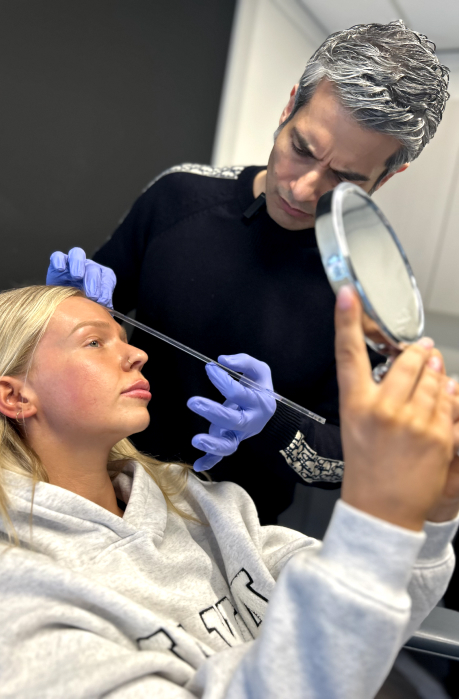
Once you begin your in-person training, the focus shifts to real-time application. Arrive ready to learn actively, accept feedback, and practice multiple times throughout the session.
1. Live Demonstrations by an Expert Injector
Your instructor will begin by demonstrating each injection technique on a real model. This is your chance to observe:
- Needle angles
- Injection speeds
- Product placement
- How to adjust based on anatomy
- Patient communication during injections
- Safety positioning and hand stabilization
Watching closely sets the tone for your own technique.
2. Guided Injection Practice on Live Models
This is the core of your practical training. Under supervision, you will inject real models while the instructor evaluates and corrects your technique. Expect guidance on:
- Where to place each injection
- How deep to inject
- How to hold and angle your needle
- How to reduce patient discomfort
- How to maintain consistency across injection points
Each correction helps build long-term muscle memory.
3. Immediate Feedback to Improve Precision
Feedback during practice is essential. Your instructor may adjust your hand position, recommend a different depth, or point out subtle asymmetries. This feedback helps refine your technique faster than online courses alone.
4. Safe Handling and Clinical Protocols
You will learn how to:
- Prepare syringes
- Maintain sterile technique
- Store and handle neurotoxins
- Manage post-injection care
- Recognize warning signs
These protocols prepare you for safe practice in actual clinical settings.
Tips to Get the Most Out of Your Hands-On Neuromodulator Training
To fully maximize the value of your practical session, apply these evidence-based strategies.
Take Notes During Instructor Demonstrations
Document injection patterns, angles, and corrections. These notes become invaluable once you start treating your own patients.
Ask for Repetition When Needed
If a technique feels unfamiliar, ask to repeat it. Hands-on learning is about building confidence through practice, not moving quickly through stations.
Watch Other Students Inject
Observing others helps you learn from different face shapes and muscle patterns. You gain insights you may not experience with your own model.
Request Additional Guidance on Complicated Areas
You can ask for extra help in areas many beginners find challenging, such as:
- Brow lifting
- Masseter injections
- Gummy smile correction
Mastering these early helps set you apart as an injector.
How to Keep Improving After Your Hands-On Training
Your growth should continue well after your practical session ends.
- Revisit your online modules to reinforce what you practiced in person.
- Shadow experienced injectors when possible. Observing skilled injectors accelerates your learning curve.
- Once basic neuromodulators are mastered, move into fillers, advanced neuromodulator techniques, and facial balancing.
Taking the Next Step With AACM™
Online neuromodulator courses are an excellent way to build your foundational knowledge, but the hands-on portion is where you transform that knowledge into practical skill. By preparing thoroughly, actively engaging during your practical session, and continuing to develop your technique afterward, you position yourself for long-term success in the aesthetics field.
The AACM™ online neuromodulator and filler training program offers a comprehensive path for new injectors. The 8.5-hour online curriculum, 180 days of unrestricted access, 24/7 instructor support, and a structured 3-day shadowing experience is designed to ensure your hands-on training feels meaningful, guided, and directly connected to what you learned online. Graduates can also earn AACM™ board certification and the FAACM® credential, giving you both the clinical skills and professional recognition needed to step confidently into aesthetic medicine. Call now at (425) 864-3777 to learn more about the course.